


Sun cross
From Wikipedia, the free encyclopedia
 | This article needs additional citations for verification. Please help improve this article by adding reliable references. Unsourced material may be challenged and removed. (June 2007) |

Contents[hide] |
[edit] Stone Age
Crossed circles scratched on stones have been recovered from Paleolithic cave sites in the Pyrenees.[citation needed]At the Callanish Stones in the Outer Hebrides, the most famous megalithic site in Scotland, crossing avenues of standing stones extend from a circle. Scratched into stone or painted on pottery, as on that of the Samara culture, the crossed-circle symbol appears in such diverse areas as the Pyrenees, Anatolia, Mesopotamia, the Iranian plateau, and the cities of Mohenjo-daro and Harappa in the Indus River valley.[citation needed]
[edit] Bronze Age Europe
In the prehistoric religion of Bronze Age Europe, crosses in circles appear frequently on artifacts identified as cult items, for example the "miniature standard" with an amber inlay that shows a cross shape when held against the light, dating to the Nordic Bronze Age, held at the National Museum of Denmark, Copenhagen.[2] The Bronze Age symbol has also been connected with the spoked chariot wheel, which at the time was four-spoked (compare the Linear B ideogram 243 "wheel" 𐃏.) This technological innovation, invented by the late Proto-Indo-Europeans reached Europe in the mid-2nd millennium BC. In the context of a culture that celebrated the Sun chariot, it may also have had a "solar" connotation.- Wheel pendants dating to the second half of the 2nd millennium BC, found in Zürich, are held at the Swiss National Museum. Variants include a six-spoked wheel, a central empty circle, and a second circle with twelve spokes surrounding one of four spokes.
- Ornamental pins, found in Switzerland, date to the first half of the 2nd millennium BC; their circular heads are incised with crosses.


[edit] Iron Age and Classical Antiquity
Further information: Wheel-god
The wheel appears as a solar motif in Celtic mythology, presumably associated with Taranis, e.g. on the Gundestrup cauldron, and at an altar to the sun god at Lypiatt, Gloucestershire.It has been claimed,[3] but also denied,[4] that the Celtic cross was originated by combining the sun cross with the plain Christian cross. See Celtic cross.
[edit] Late Antiquity--Early Medieval
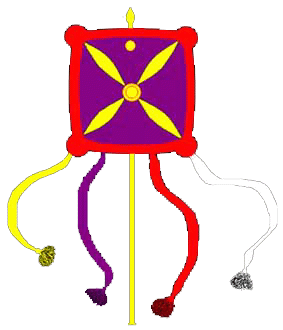
The Sassanian Empire, which is called Eran Shahr (Aryan Empire) in Middle Persian,[5] used a symbol similar to the sun cross on its vexilloid, which is called the Derafsh Kaviani.[6][7][edit] Contemporary symbolism
In Wicca and other neo-Pagan religions the sun cross most commonly represents the sun and the four quadrants the wheel of the year, i.e. the four seasonal cycles of the year.In astrology, the cross in a circle represents the planet Earth, formerly believed to be the center of the cosmos in Classical times.
The Norwegian Nazi party Nasjonal Samling used a golden sun cross on a red background as its official symbol from 1933 until 1945. The cross within a circle was ascribed to Saint Olaf, the patron saint of Norway, and the colours were those of the coat of arms of Norway. The Bulgarian national socialist movement Ratnik also used a sun cross as its official symbol. Various white nationalist and Neo-Nazi groups use the sun cross to represent the white race, i.e., the Western or European branch of the Indo-European peoples.
In the Ascended Master Teachings, a group of religions based on Theosophy, the most important deities are St. Germain and the Master Jesus. St. Germain is regarded as having a twin flame (divine complement or celestial wife) who is an ascended lady master named Portia. In iconography of the Lady Master Portia, she is shown as wearing around her neck a white sun cross with a violet background, since she works with St. Germain, who is regarded as the master of the seventh of the seven rays, the violet ray.[8]
[edit] See also
[edit] References
- ^ Symbolism of sun cross (symbols.com)
- ^ entry at the Nebra sky disk exhibition site (landesmuseum-fuer-vorgeschichte-halle.de)
- ^ Stephen Walker, "Celtic Cross History and Symbolism", Celtic Arts website, accessed 22 Nov 2008
- ^ Werner, Martin (1990). "On the Origins of the Form of the Irish High Cross". Gresta 29 (1): 98–110. Retrieved 2009-05-22.
- ^ Wiesehofer, Joseph Ancient Persia New York:1996 I.B. Tauris
- ^ Website honoring Dr. Kourosh Aryamanesh—Depicts images of the Derafsh Kaviani:
- ^ Image of the Derafsh Kaviani:
- ^ Image of the Lady Master Portia, twin flame (celestial wife) of St. Germain (her image is at the end of the "P" section, at the bottom of the web page):


Aucun commentaire:
Enregistrer un commentaire